

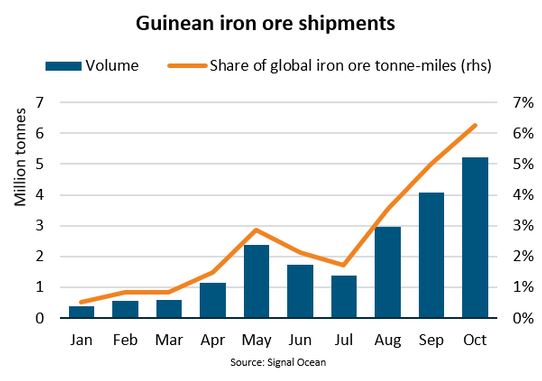
“In October 2026, Guinea became the world’s third-largest iron ore exporter, with exports surpassing 5m tonnes for the first time and accounting for 3% of global iron ore volumes. The country has gradually ramped up shipments following the start of mining operations at Simandou in December 2025. More than 22m tonnes have been shipped so far in 2026, already surpassing initial industry projections of around 20m tonnes for the full year,” says Filipe Gouveia, Shipping Analysis Manager at BIMCO.
The Simandou mining project is in southeastern Guinea and contains one of the world’s largest deposits of high-grade iron ore. Once fully ramped up, the project is expected to have an annual capacity of around 120m tonnes, equivalent to an average of 10m tonnes per month. With exports surpassing 5m tonnes in October, Guinea has already reached around half of Simandou’s planned monthly capacity. Full capacity is projected to be reached towards the end of the decade, although the exact timescale remains uncertain.
“Guinean iron ore exports are particularly beneficial for ship demand, as they typically travel 88% longer distances than the average iron ore shipment. Consequently, the exports accounted for 6% of global iron ore tonne-mile demand in October. Overall, the increase in Guinean shipments contributed to a 2% y/y increase in global iron ore tonne miles between January and October, despite stagnant cargo volumes,” says Gouveia.
Guinean iron ore has headed almost exclusively to China, the world’s largest iron ore importer. China relies on a combination of high-grade imported iron ore and domestic supplies, which are often of a lower grade, to supply its steel industry.
So far this year, China’s steel production has fallen 3% y/y due to weaker demand, while iron ore shipments to the country have risen 1% y/y. Growing supply from major exporters, including Guinea, has weighed on iron ore prices, making imported ore increasingly competitive with domestic Chinese mining. At the same time, lower prices have intensified competition among exporters, prompting some smaller Brazilian miners to reduce output amid weaker prices and high freight costs.
“Simandou could have a significant impact on capesize ship demand, even if its exports partly displace existing iron ore trade. Global iron ore tonne-mile demand could rise 13% compared with 2025 if Guinean exports reach 120m tonnes while other exporters maintain their volumes. Even if every additional Guinean tonne replaces an existing shipment, the longer sailing distances could still increase tonne-mile demand by around 6%,” says Gouveia.